Commercial · Bolton
Panic & Exit Hardware in Bolton
The daycare wants the yard gate and the classroom door alarmed so a staff member hears the moment it opens, without turning either into something a child could be shut behind.
Panic & Exit Hardware
In plain words
A tenant fit-out is a common point to bring exit hardware into a space for the first time. As walls move and a room's intended use becomes clear, the doors serving it get measured against that use: occupancy, fire rating, width and whether the space now qualifies as an assembly occupancy. Specifying and fitting the hardware alongside the rest of the fit-out, rather than after an inspector flags it, keeps the schedule intact and gives the space a documented exit from the day it opens.
How the visit goesSomeone at the front counter always has to unlock the side door by hand before the lunch rush, because the round doorknob out there was never meant to be an exit for a room this size.
Bolton
How the visit goes
Is this door part of a pair?
Single doors and pairs get assessed differently from the first look. On a pair, the locksmith checks whether a mullion currently splits the opening, whether a coordinator is already fitted, and whether the leaves close independently or in a set order. This decides whether the project is a straightforward device swap on each leaf or something larger, such as removing a mullion and fitting a compatible replacement latching arrangement to turn two narrow doors into one wide exit. Getting this right at the assessment stage avoids ordering hardware for a single door when the opening is really two leaves working together.
Choosing the device for the opening
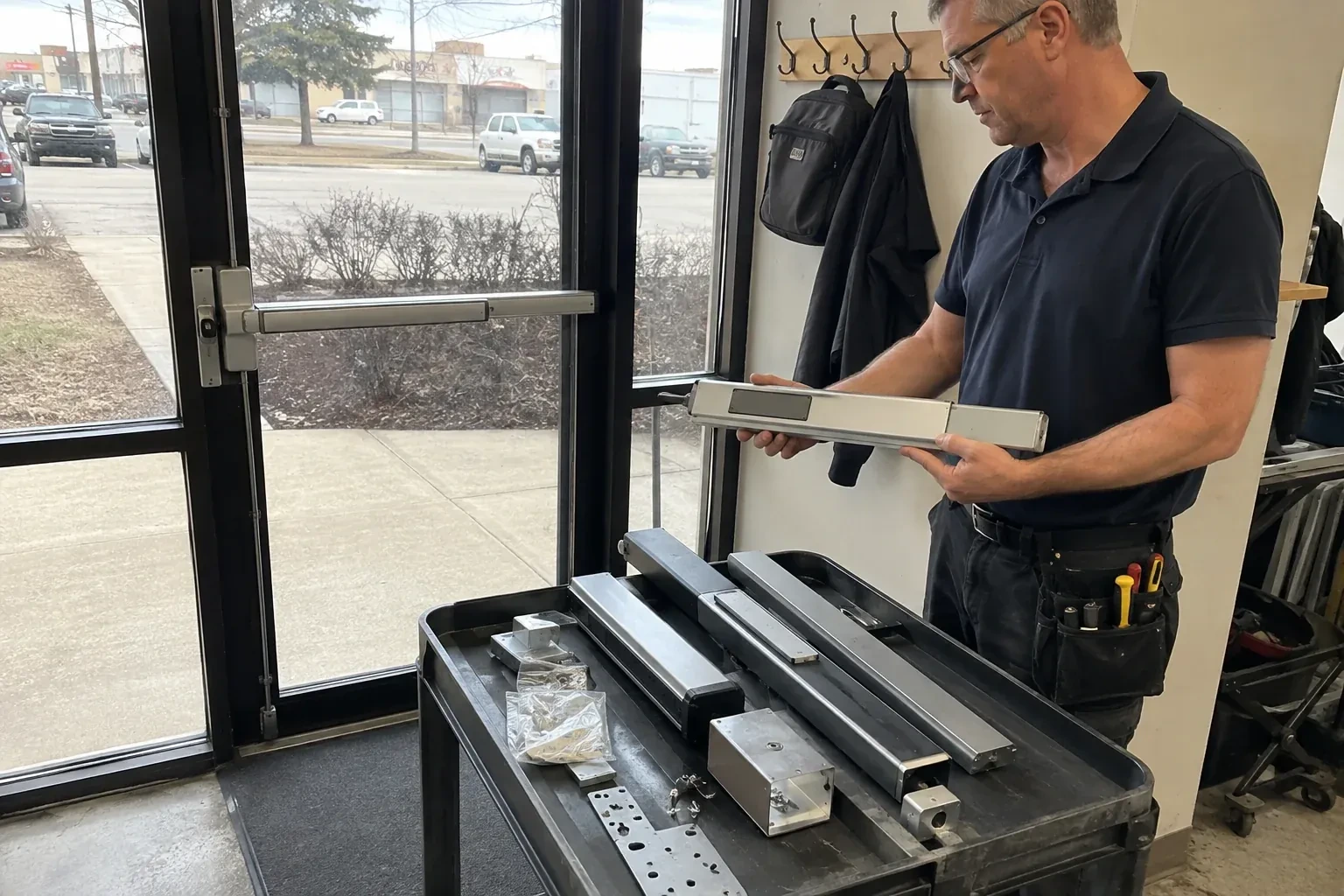
With the assessment done, the locksmith matches a device family to the door: a rim exit device for most single doors, a mortise device where a heavier-duty case suits the opening, or a vertical-rod device where latching is needed at both the top and bottom of the frame. Fire-rated openings take fire exit hardware specifically listed for that duty, never a standard panic device pressed into a role it was not built for, and listed rim fire-exit hardware covers a wide range of those openings on its own. The chosen device is matched to the door's width, handing and existing preparation before it is ordered.
Entry that stays separate from exit, permanently
The building keeps full control over who enters through the trim on the outside of the door, independent of what happens on the inside. A lost key, a staff change or a new access-control card affects only the entry side; the exit side keeps working exactly as it did on installation day. That separation is the point of the whole installation, and it is worth remembering when any future change is proposed for that door, so entry security is never solved by touching the inside crossbar.
Panic & Exit Hardware
In the van
- Installation template and jig
- Through-fixings and mounting hardware
- Outside trim (pull, lever or cylinder)
- Dogging key or keyed cylinder
- Strike and reinforcement
What affects the quote
Same fees day, night or weekend
1Number of keys or dogging cylinders
Cutting keys for the outside trim and providing a dogging key or keyed dogging cylinder for the device is counted individually, the same way any keyed hardware is.
2Occupancy and code documentation needed
A project with a fire inspector's note or a building official's requirement attached usually needs a more detailed written record than a straightforward upgrade an owner requests on their own initiative.
3Access-control integration
Where the door ties into an existing access-control panel, coordinating the exit hardware's signals with that system takes planning with whoever maintains it, which the quote accounts for separately from the device itself.
Panic & Exit Hardware: questions
What happens with a pair of doors instead of one?
It depends on the pair. Some latch independently and need nothing extra. Where the hardware calls for a set closing order, a coordinator lets the two leaves close in the right sequence, letting the active leaf's device seat properly into a strike carried on the inactive leaf, or into an astragal. Alternatively, the centre mullion can be removed and a vertical-rod device fitted to each leaf, turning the pair into one wide exit. Whichever applies, both leaves are tested working together, not one at a time.
How is panic hardware different from fire exit hardware?
Panic hardware and fire exit hardware share the same push-to-release action, but fire exit hardware is additionally tested and listed for use on a fire-rated door assembly. That extra listing matters because a fire door has to keep an active latch bolt at all times; it cannot carry a mechanical dogging function the way ordinary panic hardware sometimes can, so the two are not interchangeable on a rated opening.
Can a padlock or extra deadbolt stay on a door that has this hardware?
No additional fastening should stay on an exit door that does not release the same way the primary device does. A hasp, padlock or separate deadbolt added at some point for extra security is a common finding on an older door, and removing or replacing it with something that releases under the same push is part of bringing that opening back to a single, reliable exit.
Commercial Locks
- Master Key System DesignA new hire at the shop gets handed whatever spare key happens to be in the drawer, and it turns out…
- Access Control InstallationYou just leased the empty unit next door and want the new tenant to open their own suite without a…
- Commercial-Grade Lock ReplacementA new tenant moved into the unit next door, and the property manager just found three different…
Panic & Exit Hardware near you
Below is the full menu of lock and key work available in Bolton, written for people who are not locksmiths. Each entry says what the service is, when it makes sense, and roughly how a visit unfolds, so you can arrive at the door already knowing what the technician is going to do and why.