Commercial · Caledon
Commercial-Grade Lock Replacement
A new tenant moved into the unit next door, and the property manager just found three different cylinders on three doors, none of them cut to the same key.
Commercial-Grade Lock Replacement
In plain words
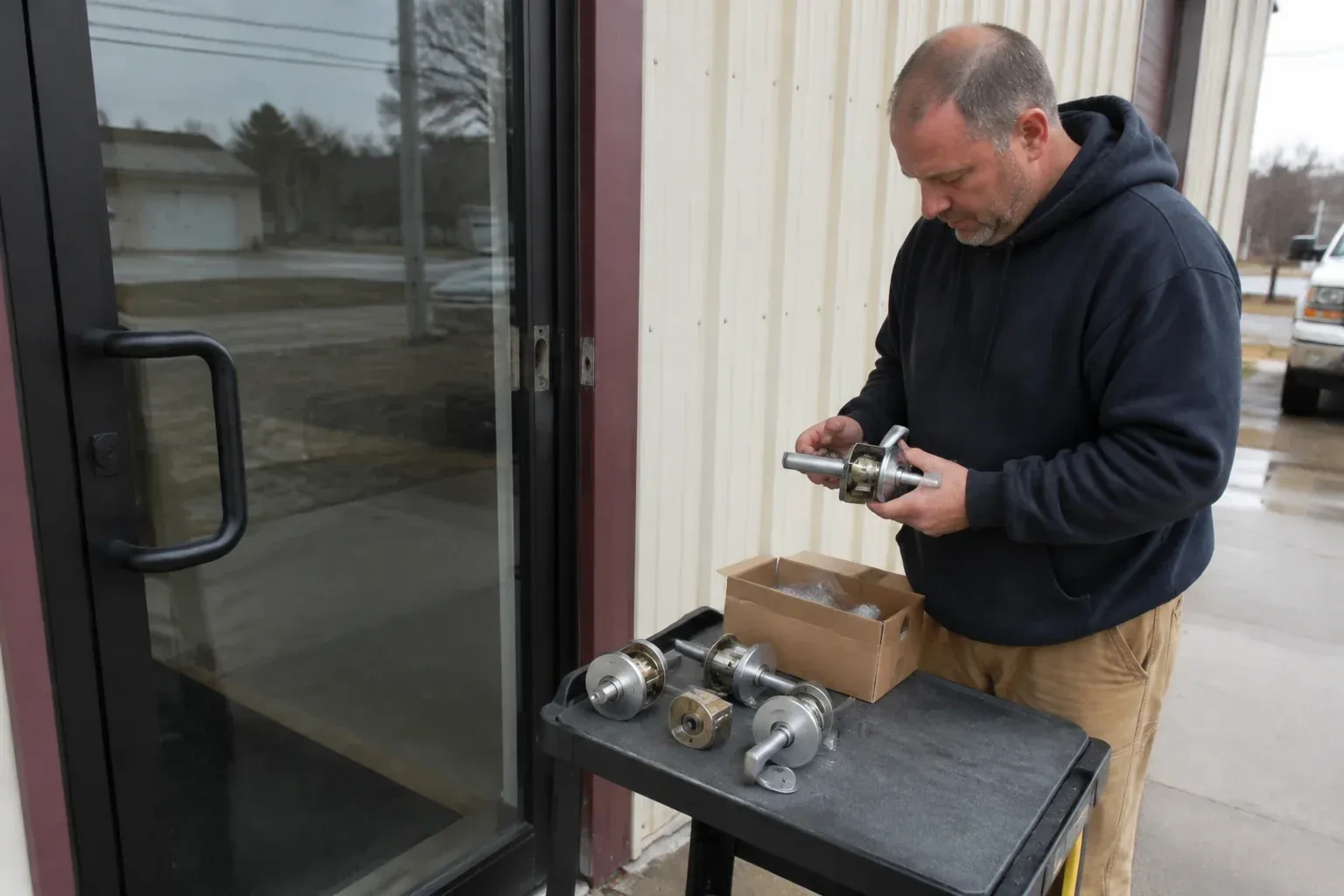
Where a home lockout is mostly about getting one door open again, a commercial lock replacement is mostly a decision about a system: how this one door's hardware fits into every other lock the business already manages. The locksmith examines the existing keying, whether cylinders are standard, interchangeable-core or restricted, and whether other doors should be keyed the same way as this one. New hardware is chosen to match the door's fire rating and occupant load where those apply, installed without altering the door's existing prep, and finished with keys cut, tested and recorded in the business's own key-control log.
How the visit goesAt closing time the hookbolt on the storefront door catches the keeper only on the second or third try, and one employee has started giving the door a shoulder to force it home.
Caledon
How the visit goes
Weighing what the new hardware needs to do long term
The last part of the assessment looks past today's problem to how the business expects to manage this door going forward: does staff turnover happen often enough that an interchangeable core, which lets a key holder change the combination without pulling the whole cylinder, would pay for itself in convenience? Does the business want a restricted keyway so blanks cannot be cut at an ordinary hardware counter? These questions shape the specific hardware ordered as much as the door's physical construction does.
Testing under real conditions before signing off
The finished hardware is cycled from both sides, under the door's normal swing and closing force, and by more than one person where staff are on site to try it, since a lock that operates cleanly for one hand may bind for another depending on height and grip. Any electric strike or reader tie-in is triggered several times to confirm consistent release. Only once the hardware performs the same way on repeated tries is the work considered finished rather than merely installed.
Electrified hardware working as one system
If the door carries an electric strike, a maglock or a card-reader tie-in, that hardware has been tested together with the new mechanical lock rather than left to be sorted out separately. The release button, the reader and the mechanical latch now agree with each other, so staff are not shouldering a door that is supposedly already unlocked. Anyone monitoring the door through an alarm panel or access-control software can confirm the contact reports correctly against the new hardware.
Commercial-Grade Lock Replacement
In the van
- Restricted keyway cylinder
- Electric strike
- Interchangeable-core cylinder
- Narrow-stile storefront lock
- Hookbolt and deadlatch hardware
What affects the quote
Same fees day, night or weekend
1Removal of old hardware
Whether old locks, cylinders and strikes are left with the business, disposed of, or kept as spares for a wider system is a small choice that can affect the time and scope named in the quote.
2Electrified hardware and access-control integration
An electric strike, maglock or reader tie-in adds parts and testing time beyond a purely mechanical lock, and the quote separates that electrified work from the mechanical hardware so each is clear on its own.
3Key-control documentation
Setting up or updating a written key-control log, recording who holds which key and which doors share a system, is a small but distinct task the quote can name separately from the physical hardware work.
Commercial-Grade Lock Replacement: questions
What is the difference between a mortise lock and a cylindrical lockset?
A mortise lock has its whole mechanism, latch, deadbolt and sometimes a separate handle function, built into one case that sits inside a pocket cut into the door's edge. A cylindrical lockset is a bored-in unit, simpler to service, common on standard commercial and residential doors alike. Which one your door takes depends on how it was originally prepped, not on preference alone.
Can several branch locations be brought onto one master key system?
Yes, and it is a common request from businesses running more than one location. The locksmith works out a keying structure, a master for management, sub-masters per site or department, and individual change keys, then supplies cylinders across the locations that accept that structure. Keeping a record of the whole structure in one place is what makes it manageable afterward.
What happens to keys held by former employees or contractors?
Once a cylinder is replaced or rekeyed, any key that was not reissued for the new combination simply stops working on that door. This is the direct answer to a key that walked out with someone who left the business, and it is worth doing across every door that key used to open, not only the one that prompted the call.
Commercial Locks
- Master Key System DesignA new hire at the shop gets handed whatever spare key happens to be in the drawer, and it turns out…
- Access Control InstallationYou just leased the empty unit next door and want the new tenant to open their own suite without a…
- Panic & Exit HardwareThe daycare wants the yard gate and the classroom door alarmed so a staff member hears the moment…
Commercial-Grade Lock Replacement near you
A locksmith's week in Caledon is a mix of small fixes and bigger decisions. A cylinder rekeyed after a lost key, a deadbolt added to a door that never had one, a shop rekeyed after staff changes, a safe that finally opens. The pages below describe each service and how the visit usually goes.