Commercial · Caledon
Panic & Exit Hardware in Caledon
The daycare wants the yard gate and the classroom door alarmed so a staff member hears the moment it opens, without turning either into something a child could be shut behind.
Panic & Exit Hardware
In plain words
Which device goes on a door depends on what the door already is. A single interior door usually takes a rim exit device and a simple pull or lever outside. Listed fire-exit hardware covers many tall, narrow-stile and fire-rated openings too, so a mortise or vertical-rod device is chosen for its latching arrangement or the door's own preparation, not from height or fire rating alone, and a fire-rated opening can never be held open by a mechanical dogging function. Reading the door correctly before ordering hardware is most of the job; fitting it well is the rest.
How the visit goesTwo doors used to swing as a pair at the community hall entrance, but one leaf has started closing before the other, catching the astragal and leaving a gap wide enough to worry the caretaker.
Caledon
How the visit goes
Occupancy, fire rating and the authority reviewing the space
The assessment records the occupancy type and calculated occupant load for the room the door serves, whether the door sits in a fire separation, and who the authority having jurisdiction is likely to be, whether that is a fire inspector, a building official or an insurer. These facts, not the door's appearance or its width alone, are what decide whether a releasing device is required, whether it must also be fire-rated exit hardware, and what documentation the finished installation should carry.
Mounting the device and fitting the strike
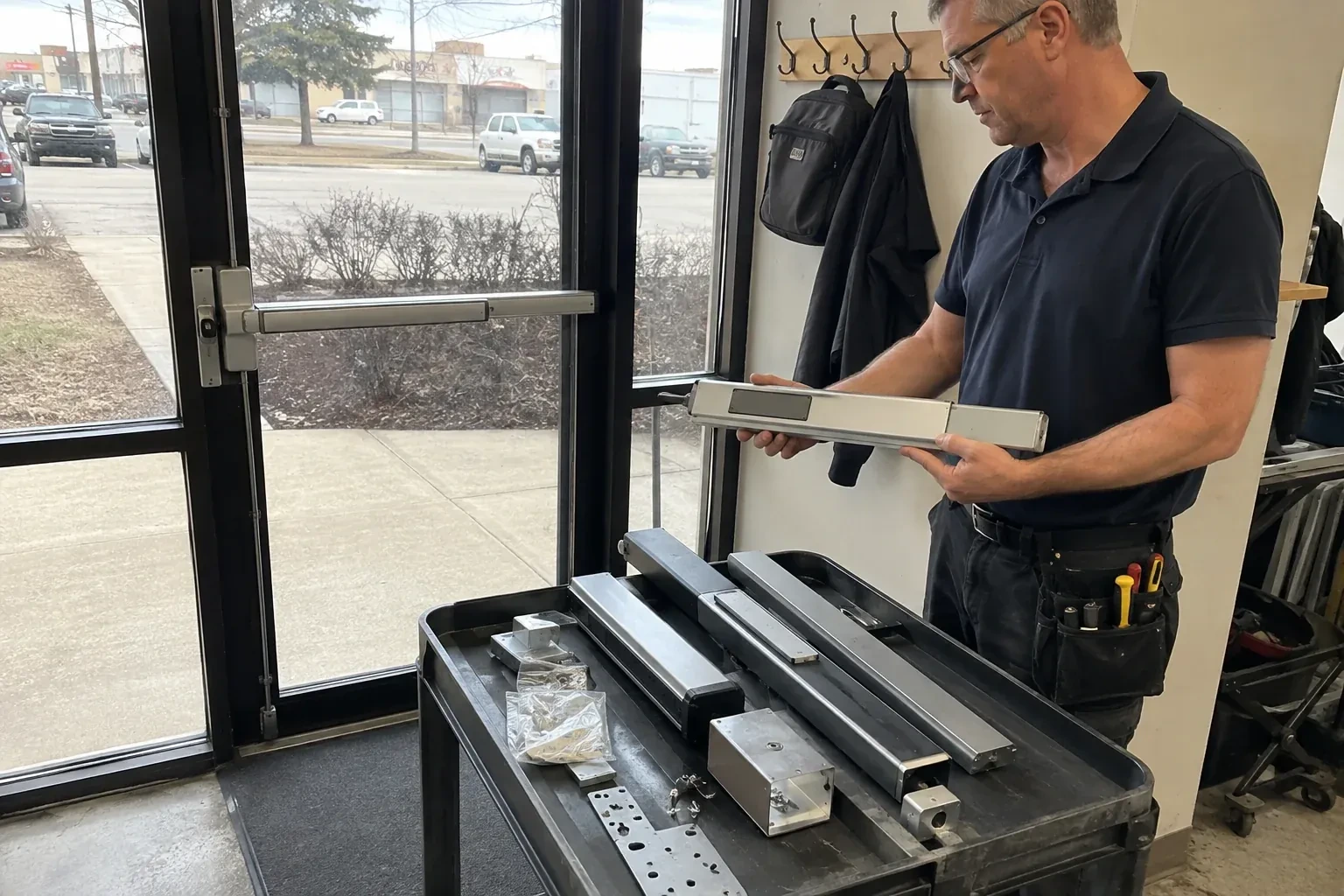
Installation follows the device's own template so every hole lands where the manufacturer intended, rather than adapting the door to a device that does not quite fit. Fasteners are chosen to match what the template and the door's own construction call for, and where the device specifies through-fixings, they run all the way through the door rather than biting into the surface alone. The strike is set and reinforced so it holds the latch securely under normal use. The crossbar or touchpad is aligned so it sits at a comfortable height and releases evenly across its width, not only at one end.
Entry that stays separate from exit, permanently
The building keeps full control over who enters through the trim on the outside of the door, independent of what happens on the inside. A lost key, a staff change or a new access-control card affects only the entry side; the exit side keeps working exactly as it did on installation day. That separation is the point of the whole installation, and it is worth remembering when any future change is proposed for that door, so entry security is never solved by touching the inside crossbar.
Panic & Exit Hardware
In the van
- Installation template and jig
- Through-fixings and mounting hardware
- Outside trim (pull, lever or cylinder)
- Dogging key or keyed cylinder
- Strike and reinforcement
What affects the quote
Same fees day, night or weekend
1Device family required
A rim device suits many single doors with modest work. A mortise or vertical-rod device, or hardware built to a fire-exit listing, takes more preparation and generally more hardware, which the quote reflects.
2Removing hardware that should not remain
A padlock, hasp or extra deadbolt found on the door is removed and the resulting holes are filled or covered as part of the same visit, which is its own small task in the quote.
3Single door or a pair
A pair of doors that needs ordered closing calls for a coordinator or an astragal, and one being converted into a single wide exit needs a mullion removed and replaced with vertical-rod devices on each leaf, both of which add work beyond a single-door installation.
Panic & Exit Hardware: questions
What happens with a pair of doors instead of one?
It depends on the pair. Some latch independently and need nothing extra. Where the hardware calls for a set closing order, a coordinator lets the two leaves close in the right sequence, letting the active leaf's device seat properly into a strike carried on the inactive leaf, or into an astragal. Alternatively, the centre mullion can be removed and a vertical-rod device fitted to each leaf, turning the pair into one wide exit. Whichever applies, both leaves are tested working together, not one at a time.
How is panic hardware different from fire exit hardware?
Panic hardware and fire exit hardware share the same push-to-release action, but fire exit hardware is additionally tested and listed for use on a fire-rated door assembly. That extra listing matters because a fire door has to keep an active latch bolt at all times; it cannot carry a mechanical dogging function the way ordinary panic hardware sometimes can, so the two are not interchangeable on a rated opening.
Can a padlock or extra deadbolt stay on a door that has this hardware?
No additional fastening should stay on an exit door that does not release the same way the primary device does. A hasp, padlock or separate deadbolt added at some point for extra security is a common finding on an older door, and removing or replacing it with something that releases under the same push is part of bringing that opening back to a single, reliable exit.
Commercial Locks
- Master Key System DesignA new hire at the shop gets handed whatever spare key happens to be in the drawer, and it turns out…
- Access Control InstallationYou just leased the empty unit next door and want the new tenant to open their own suite without a…
- Commercial-Grade Lock ReplacementA new tenant moved into the unit next door, and the property manager just found three different…
Panic & Exit Hardware near you
A locksmith's week in Caledon is a mix of small fixes and bigger decisions. A cylinder rekeyed after a lost key, a deadbolt added to a door that never had one, a shop rekeyed after staff changes, a safe that finally opens. The pages below describe each service and how the visit usually goes.